The success of Gojira (1954) resulted in Toho fast-tracking a sequel. And I do mean fast. Gojira was released in Japan on November 3rd, 1954. Godzilla Raids Again (1955) premiered in Japanese cinemas on April 24th, 1955, not even six months later. The rushed production schedule is occasionally evident in the final film, but the movie is mainly notable for introducing what would become staples of the series and the long, tortuous path it took in getting to U.S. theaters.
Godzilla Raids Again opens with pilots Shoichi Tsukioka and Koji Kobayashi, both scouting for fish on behalf of their employer, Kaiyo Fishing Incorporated. Through a surprisingly leisurely series of aerial shots, Tsukioka spots some tuna, and radios in to alert the fishing ships to converge on his coordinates. In the process we learn that he’s engaged to marry Hidemi Yamaji, one of the radio operators, who is also his boss’ daughter.
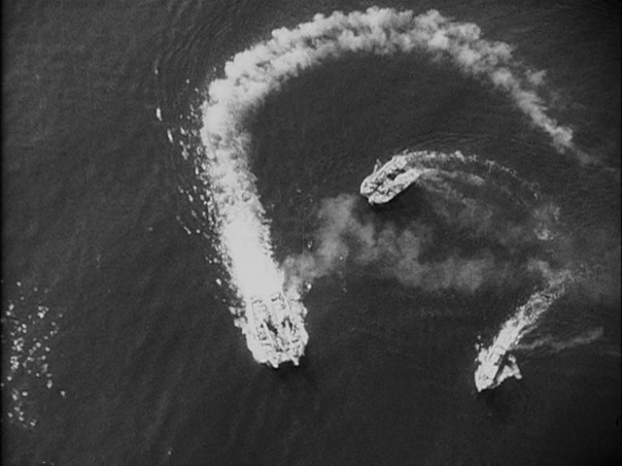
If you like aerial footage of fishing ships, boy did you pick the right movie.
Kobayashi radios in to report engine trouble, and is forced to put his seaplane down near Iwata Island. Tsukioka is dispatched to rescue his friend, and finds him waving for help in a location that looks drastically different depending on whether it’s shown in long shot or close up. They reunite on the beach and start a fire to dry their wet clothes, when a familiar roar heralds the arrival of a new Godzilla, just on the other side of the island. Shortly afterward, a new roar is heard, that of new kaiju Anguirus.
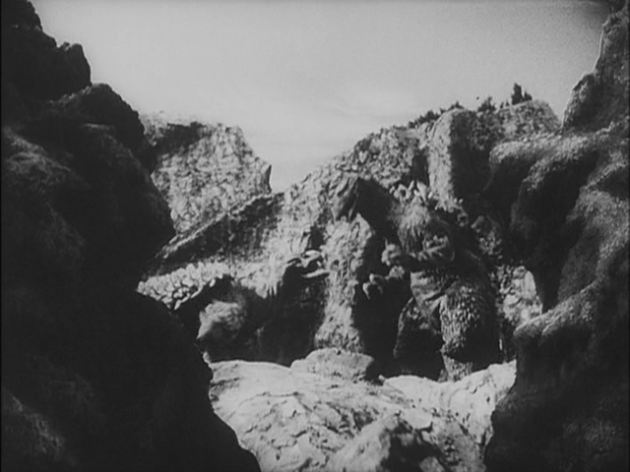
Shit just got real.
Realizing the gravity of the situation, the two men retreat into a narrow crevice. The two monsters battle, shaking the rocky island like an earthquake and generally terrifying the poor guys with falling dust and debris.

“If only we had some kind of eye protection handy!”
The battle is a short one, as the monsters run out of space and tumble into the ocean after only a few exchanges, but the stakes have been upped. Godzilla is back, and he brought a sparring partner. Tsukioka and Kobayashi flee while they have the chance.

“Argh, I hate it when you pull this ‘Ring Out’ crap! Just fight!”
Back at Osaka City Police Headquarters, the pilots are given a bunch of dinosaur books to leaf through, in the hopes that they can identify the new monster. Kobayashi picks out a picture that looks exactly like it, probably because it’s very obviously concept art for the film. The scientist helping them says it’s called an anguirusaur also known as Anguirus. This is a rough approximation of the Japanese pronunciation of “ankylosaur,” which is the primary inspiration for Anguirus’ armored quadrupedal design.
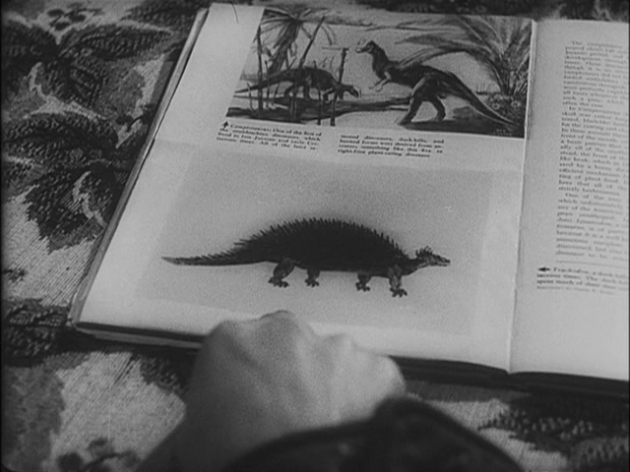
“Yes, this picture that totally wasn’t pasted onto this book’s page by the prop department bears a striking resemblance to what I saw.”
Tadokoro, a zoologist who seems to actually be a paleontologist, explains the science with greater success than Professor Yamane did in Gojira. Anguirus is said to have lived 70 to 150 million years ago, putting him firmly in the Cretaceous Period. Oddly, he goes on to note that Anguirus is 150 feet tall and has three brains – one in his head, one in his chest, and one in his stomach. In the previous film, Godzilla’s great size was attributed to being a radioactive mutation, but in Godzilla Raids Again, the scientific text implies that members of Anguirus’ species are simply that big naturally. It’s also noted that “Anguirus are aggressive against other species,” which is essentially impossible to know from the fossil record, but meant as an explanation of the monsters’ constant fighting. The identity of the newcomer now nailed down, attention turns to Professor Yamane, returning from the first film, for advice on how to stop the two beasts.
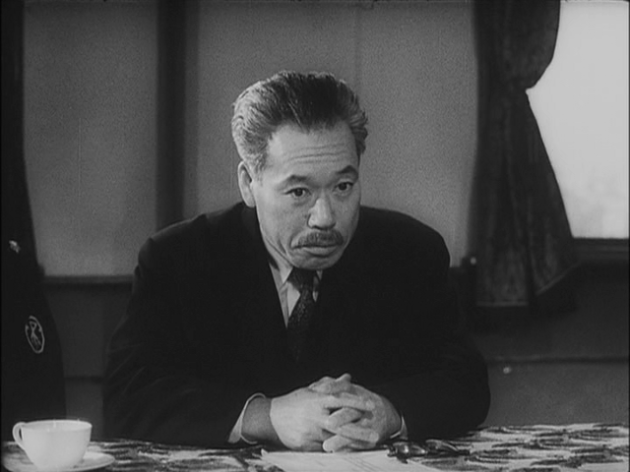
“We’re all going to die. Now, if you don’t mind, I have to catch a plane to some place really, really far inland.”
Yamane recaps the events of the first film, including the fact that there is no defense against Godzilla now that Dr. Serizawa has taken the secret of the Oxygen Destroyer to the grave. Killing Godzilla and Anguirus is essentially impossible now, and Yamane runs footage from Gojira to drive his point home, referring to the monster with the eminently sick burn, “that terrifying, radiation-containing, atrocious Godzilla.” The footage, being from the film itself, showcases some amazing angles for in-universe footage shot of the actual attack. Apparently Japanese news cameramen are utterly fearless.
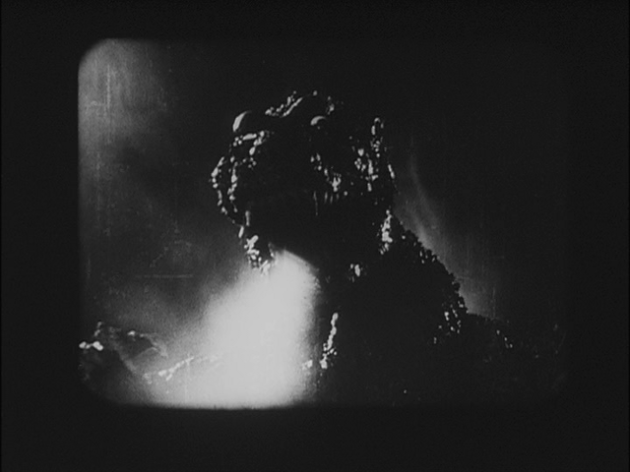
“Yeah, it was a tough angle to get with a 50-pound film camera on a tripod, but it was worth it!”
Yamane suggests that since Godzilla showed some responsiveness to light, perhaps they could lure him away from more heavily populated areas using flares during a full blackout. With no offensive measures available to them, Japan’s Self Defense Forces decide to try this option. Officials gather around a map as scouts report back on Godzilla’s whereabouts. When his location is pinpointed, they mark it using the cutest enemy marker ever made.
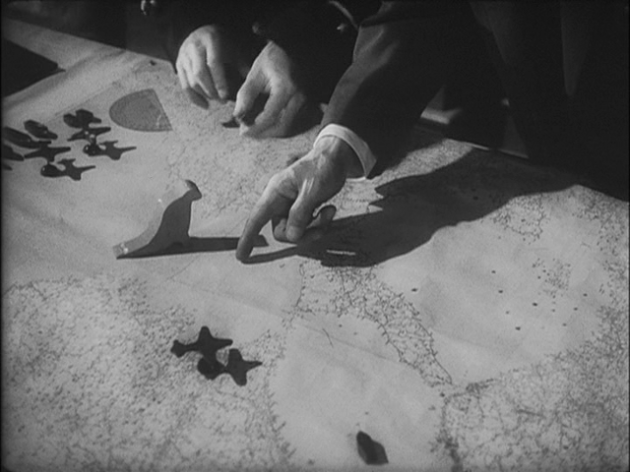
“The planes will drop the flares starting 100 yards east of the adorable papercraft dinosaur.”
While Godzilla Raids Again has far less social commentary than its predecessor, there is a somewhat prominent subplot regarding the potential loss of infrastructure that the monster attacks cause. Tsukioka’s boss is concerned that Godzilla surfacing near their location will lead to the destruction of the dock the fishing company uses. There may be an allusion here to the undoing of all the post-war reconstruction work, but it’s pretty thin.
Meanwhile, Osaka’s nightlife is alive and kicking, as we’re shown the brightly neon-lit entertainment district, complete with what appears to be a neon blackface caricature selling pipe tobacco.
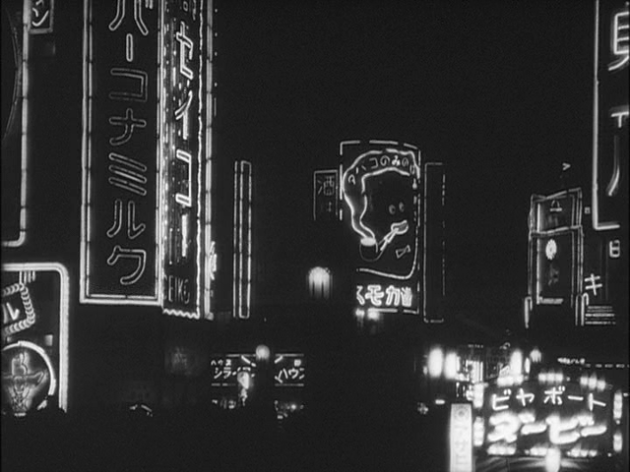
Thanks for the imported racism, U.S. Occupation Forces!
Tsukioka and Hidemi are kicking it up at a dance club. Godzilla has no love for dance parties (yet…see Godzilla vs the Sea Monster (1966)), so he chooses that moment to surface, en route to Osaka Bay. In another wartime allusion, Osaka goes into full blackout as planes fly out to meet Godzilla to draw him off with flares. Tanks, previously proven to be ineffective against Godzilla, also roll into position for no reason whatsoever.

Might as well waste some lives and expensive hardware while the opportunity presents itself.
The flares are dropped, and catch Godzilla’s attention. Surprisingly, the plan works, and he begins following the flares away from the densely populated city. It’s here that we get our first look at this movie’s Godzilla in closeup. He’s not too far off the Gojira version, but this new Godzilla skipped a lot more orthodontist appointments.
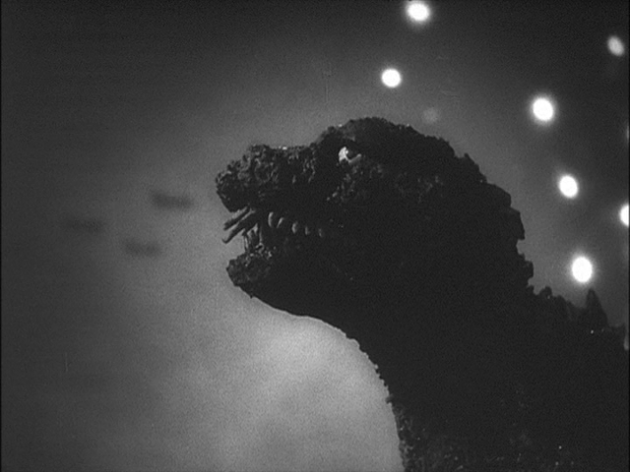
“I like the pretty lights.”
Elsewhere, a paddy wagon (I feel dumb typing “paddy wagon,” but I honestly don’t know any other way to describe it) is transporting prisoners, which, as everyone knows, is best done during a total blackout while a giant monster threatens the area. The prisoners stage an escape by overpowering their guards, stealing their weapons, and fleeing into the night.
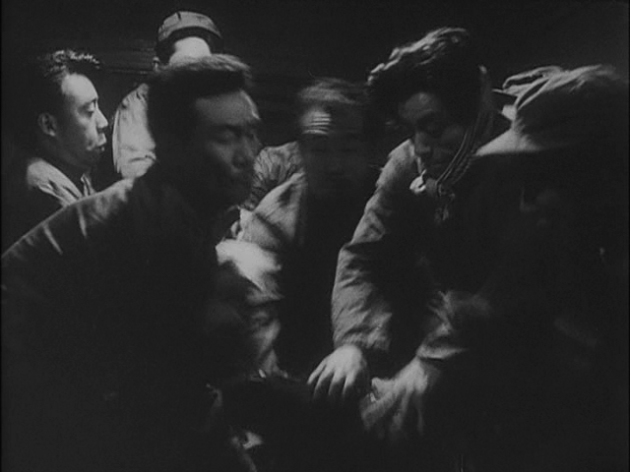
“Handcuffs? Why would we put them in handcuffs?”
Three of the prisoners steal a chemical truck, and pursuing officers commandeer a passing car to pursue. Conveniently for the plot, the car’s occupants happen to be Tsukioka and Kobayashi, returning from dropping Hidemi at her father’s house for safety’s sake. A minor chase sequence results, with a strange editing quirk. Every time the stolen truck passes the camera, a very obvious cut occurs, and then our heroes’ car and an accompanying police car pass by in pursuit. Bad timing on the stunt driving? Couldn’t get the cars and the truck rented on the same day? The world may never know.
Because the prisoners are slapstick idiots, they get so wrapped up in escaping that they don’t notice a brick wall directly in front of them. They smash through it, flipping over and crashing into a factory full of flammable material. The truck and the factory go up in a tremendous fireball, which is unfortunately brighter than the military’s aerial flares. Godzilla’s attention is drawn back to Osaka. The military opens fire with its completely ineffectual tanks and missile launchers, pretty much guaranteeing Godzilla will continue heading toward the city.
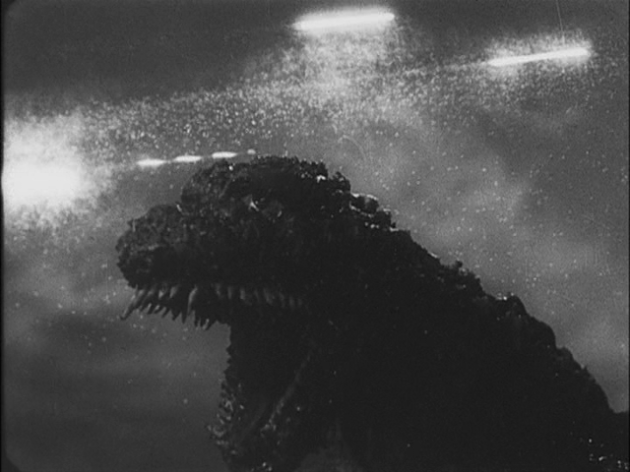
“You’re just wasting my time and yours!”
Just in the nick of time, Anguirus surfaces and faces off against Godzilla. They fight while the military continues to shell them, providing flashes of light and smoke effects the filmmakers can use to cover up the very rubbery way the suits interact with one another. Sometimes there are closeups that look for all the world like two Muppets banging into one another.
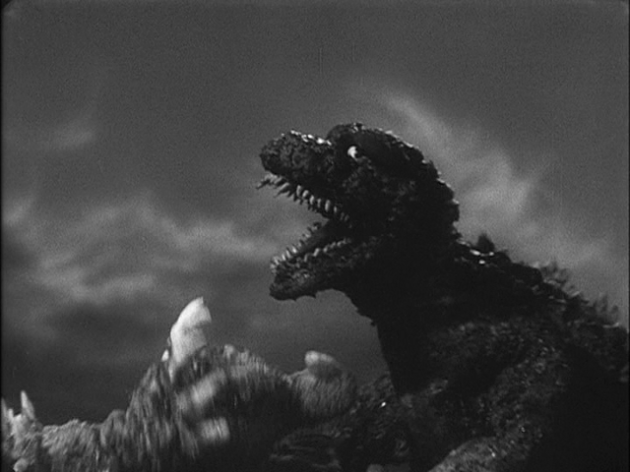
“WOCKA WOCKA WOCKA!”
There’s really not a lot of choreography happening here. There’s some sumo going on, but about an equal amount of schoolyard slapfight. Later movies would refine the fights into carefully orchestrated centerpieces, but there seems to have been little specific direction given in Godzilla Raids Again.
A mistake during production also makes things a bit weird. Normally in kaiju films, the camera is overcranked so the monster scenes can be shot at a higher framerate, then played back slower so as to give the creatures a sense of scale and weight. In fact, Haruo Nakajima, the man who played Godzilla and several other Toho kaiju for 23 years starting with the original Gojira, eventually figured out that he had to move at two or three times normal speed to make the movements look right when played back; no easy feat in a bulky rubber monster suit. However, the camera operator on Godzilla Raids Again mistakenly undercranked the camera, so that when played back at normal speed the monster fights look artificially sped up, like an old silent comedy. Director Motoyoshi Oda decided he liked the look, so the footage was kept, but one suspects the truth was that he just didn’t have the time or budget to reshoot any of it.
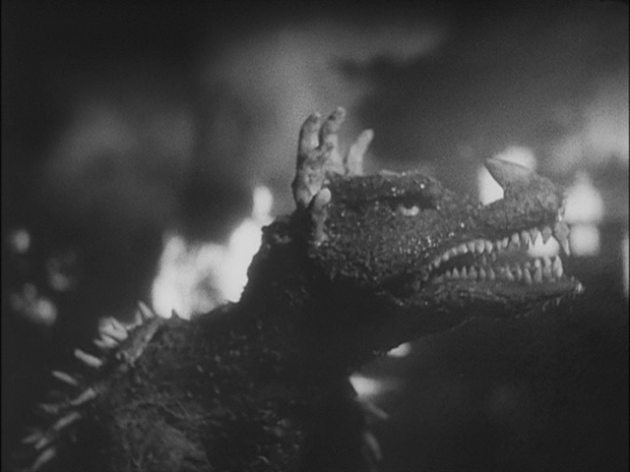
Anguirus – Toho’s Punching Bag
Of course, this is the first time two giant suitmation creatures have ever fought on camera, so some slack should probably be cut. Anguirus is an interesting addition to the roster in that he’s strikingly different from Godzilla. Most notably, he’s a quadruped most of the time, unless he needs to rear up for combat. This effect is achieved rather simply, by having the actor in the suit crawl around on his hands and knees. In later appearances, great care would be taken to try and hide Anguirus’ rear legs while walking on all fours. Anguirus would eventually become one of Godzilla’s most dependable allies, and a definite fan favorite. Being an Anguirus fan isn’t all roses, though, as he was often forced into the role of the monster who had to lose a fight to prove the new villain was a threat, and generally got stuck as second banana at best. Still, out of all of Godzilla’s numerous supporting cast monsters, he was the first, and that counts for something.
After a lot of over-sped slapping and pushing, Godzilla finally pins Anguirus against Osaka Castle, and smashes him through it. While Anguirus is stunned from this, Godzilla bites down on his neck, mortally wounding him. Anguirus falls, and Godzilla incinerates the body with his fire breath. This film, incidentally, is the only Godzilla movie in which the plates on his back do not glow when he uses his radioactive breath. Luckily for all involved (except Anguirus), Godzilla seems to have had enough action for one day and leaves the area.
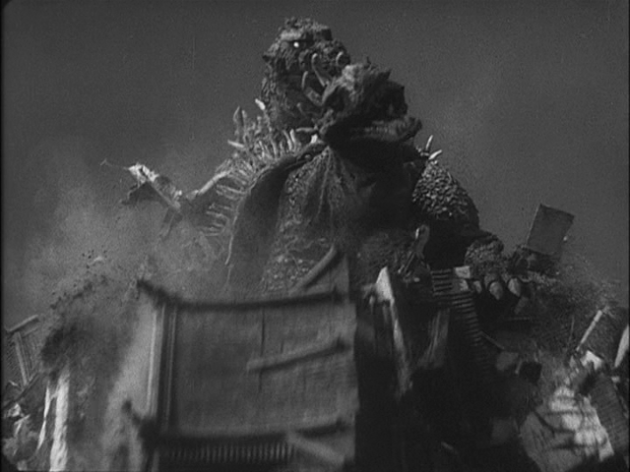
The first, but certainly not the last, mark in the “L” column for Anguirus
The Kaiyo Fishing factory has been badly damaged, and the boss tours the ruins sadly. He decides to make the Hokkaido factory up north the center of operations for now, and sends Kobayashi there to assist the fishing boats. Once there, he gets on well with the manager and the radio girls, and spots a large school of codfish for the ships. At this point a subplot involving Kobayashi’s futile search for a wife is put into full gear, with the Hokkaido crew referring to him sarcastically but affectionately as “Mr. Groom.” He claims he has chosen a co-worker as his potential mate, but doesn’t reveal who she is.
Tsukioka and Hidemi arrive in time to join a company dinner party celebrating their good catch, and Kobayashi surprises Tsukioka by inviting a bunch of their old college buddies who also flew in the same corps they did, and are part of the military operation searching for Godzilla. I haven’t delved too much into the main characters in this article, in part because they’re mostly just swept along by the plot, but it is interesting to see the contrast between the characters Godzilla Raids Again focuses on in comparison to Gojira. While Gojira was very much about top officials and scientists doing Important Work to stop Godzilla, Tsukioka and Kobayashi are fairly average working guys. Yes, they do a very specialized job, but they’re part of a team that provides a very basic life necessity to the community, and everyone at Kaiyo Fishing Inc. seems to take great pride in that role. Clearly the idea was to tell a similar story from the perspective of a regular citizen, although the result skews heavily into the realm of characters conveniently being in the right place at the right time for the plot.
While at dinner, word arrives that one of the company’s fishing ships has been lost to Godzilla, and the pilots are all mobilized to find the monster. There’s a brief scene here where Kobayashi asks Hidemi about what girls want. She lists off several gift ideas, including handbags and watches, which seems like an odd response, but Kobayashi writes it all down, so I guess that’s what he was after.
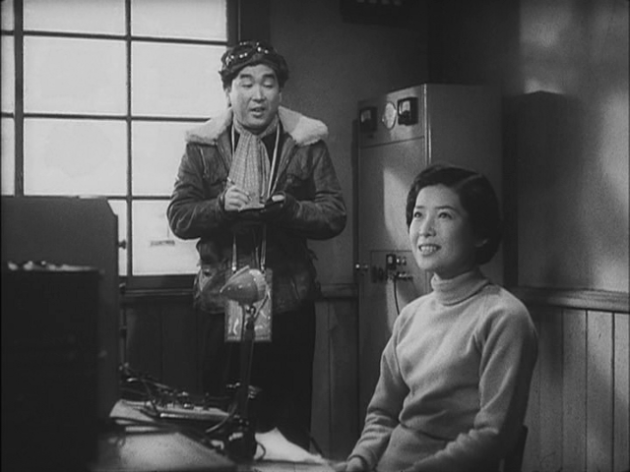
Mmm…handbags.
Tsukioka radios in that he has spotted Godzilla making landfall on an icy island, but is low on fuel. Kobayashi flies out to relieve him, accidentally leaving his notebook behind with Hidemi. She opens the book to find that the “sweetheart” he referred to earlier is actually a picture of Hidemi herself. She finds the fact that her fiance’s best friend is pining for her to be endearing, for some reason.
Kobayashi finds Tsukioka and takes over observing Godzilla as the military jets “Prepare to attack with bombs!” Presumably earlier they prepared to take off with wings. The icy island Godzilla’s on is sort of a bowl-shaped canyon in the middle, so they see a chance to hit Godzilla while his mobility is limited. Godzilla keeps trying to move toward shore, so Kobayashi begins buzzing the monster in his prop plane to distract him. The jets bombs have no evident effect, but Kobayashi keeps trying to play sheepdog, and gets tagged with a blast of fire breath for his trouble. Kobayashi’s plane smashes into the snowy mountain above Godzilla’s head, killing the hapless pilot.
The other pilots are shocked, but they also notice the avalanche of ice and snow Kobayashi’s crash causes. They realize that while their bombs may not hurt Godzilla directly, they can use them to bury the monster in freezing ice. They unload what remains of their payload, burying Godzilla up to his chest, and head back to base while he struggles to free himself.
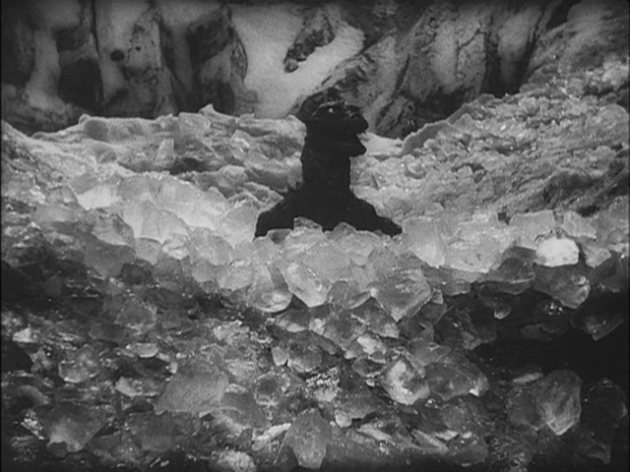
“MAKEUP!”
The pilots agree that their best shot is to use the island itself to imprison Godzilla. A group of boats arrive while Godzilla is immobilized to set up a line of explosive barrels that will create a wall of flame, keeping Godzilla trapped in the target zone. The jets arrive, this time with Tsukioka as one of their number, having begged to be included so he can avenge his friend. The boat teams shoot the barrels, sending up gouts of flame that keep Godzilla where he is.
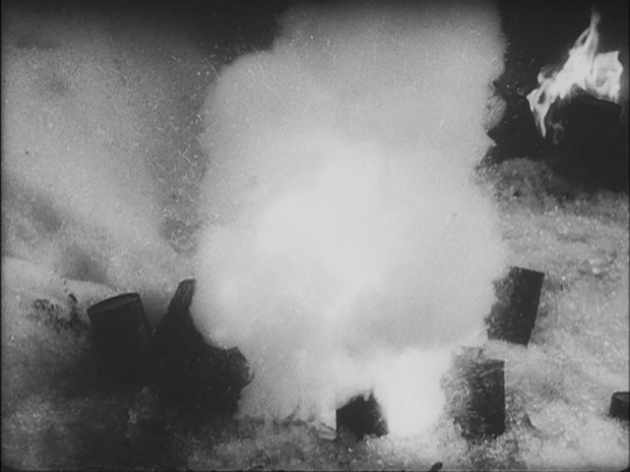
It’s a black and white movie, but we all know those barrels are red.
The jets bombard the mountains around Godzilla for a very, very long time. He takes a few out with his fire breath, and even manages to swat one out of the air. What a jet fighter with a rocket payload was doing that close to the ground or the target, we will never know. Did I mention this goes on for a while? They start reusing the explosion and “jet firing rockets” insert shots to the point that it starts to feel like some kind of prototype for a Michael Bay film.
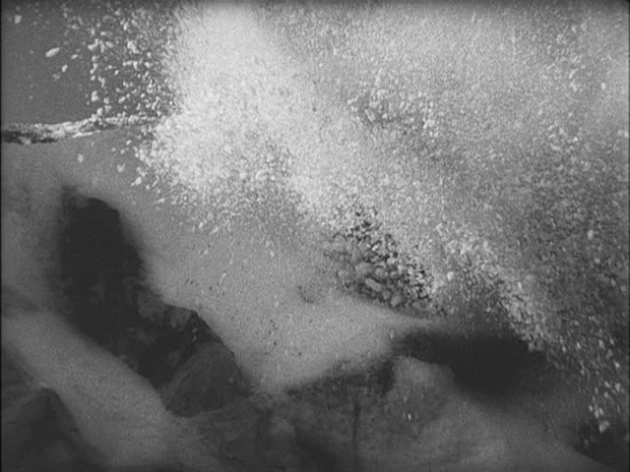
Hope you enjoy this shot, because you’re going to see about twenty more just like it.
The ice and snow slowly climb higher around Godzilla. At long last, Tsukioka makes the final shot that buries Godzilla completely. As the pilots survey their handiwork, he remarks, “Kobayashi, at last we defeated Godzilla.” The film closes with a shot of a painting of a snowy island that kind of vaguely looks like the island Godzilla was on.
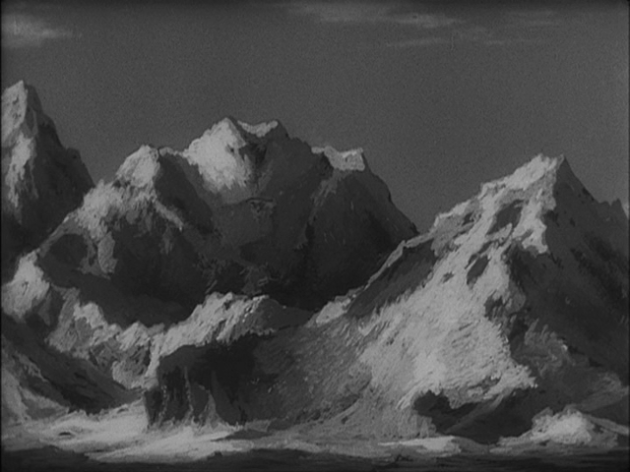
Eh…close enough.
Godzilla Raids Again is, to put it rather kindly, a mediocre entry in the series. It makes a lot of rookie mistakes, which is understandable considering it’s only the second Godzilla film. In particular, the lack of involvement from Gojira director Ishiro Honda and composer Akira Ifukube is very noticeable. The extremely short production time was undoubtedly a factor, as well, plus the fact that Godzilla Raids Again features the very first kaiju battle. The notion of a monster being humanity’s ally had not yet been introduced, so the climax of the film is not the battle between Godzilla and Anguirus, but the more sterile conflict between Godzilla and the military jets. It would be learned quickly that the draw of the genre is the warring kaiju, not insert shots of model planes. It doesn’t help that the method used to defeat Godzilla is really shaky from a logic standpoint (is a creature that hibernated for millennia really going to have trouble surviving an ice bath?), but lacks the dramatic power of the Oxygen Destroyer and Serizawa’s sacrifice.
While Gojira suffered some recutting and the insertion of Raymond Burr’s character Steve Martin, Godzilla Raids Again arrived on American shores in a far less recognizable form. Originally, a drastically altered film called The Volcano Monsters was planned to be cobbled together from some of the Japanese special effects scenes, and new footage would be shot with American actors to create an entirely new story. This production got far enough that the Godzilla and Anguirus suits were actually shipped to the U.S., because the producers wanted the monsters to be normal dinosaur-sized and not gigantic, so they planned to shoot their own scenes with the suits.
The production house went out of business before The Volcano Monsters could really start rolling, and the rights ended up in the hands of one Paul Schreibman. Schreibman opted for a far less ambitious plan of dubbing the film and releasing it relatively unaltered, except for a few odd creative choices. Either because he couldn’t secure the rights or just didn’t want to invite comparison, Godzilla Raids Again was dubbed to remove all reference to Godzilla whatsoever, and retitled Gigantis the Fire Monster (1959). The U.S. version is featured on the DVD alongside the Japanese version, and the differences are striking and sometimes hilarious.
The producers of the U.S. dub were apparently afraid of silence. Tsukioka’s dub actor talks constantly over everything, to the point of narrating the onscreen action much of the time. It’s so full of unnecessary description, it could be used as a radio play. Godzilla’s roar is often replaced by Anguirus’ roar with no real pattern evident. Godzilla himself is called Gigantis, and both monsters are vaguely described as being part of the “Anguirus family.” Kobayashi is dubbed as a blithering idiot, and the subplot about him looking for a girl is totally removed aside from Hidemi finding the photo at the end. All the original music is replaced by laughably inappropriate library music straight out of a standard issue ‘50s sci-fi film.
The most entertaining change, however, is the addition of “educational” sections. The U.S. version opens with a narration about the amazing power of the H-bomb and the monsters it has the potential to create. The footage Yamane shows of the original Godzilla attacking Tokyo is replaced with a nonsensical short film about the origins of Earth and monsters who arose from molten rock and fire in the planet’s primordial past.
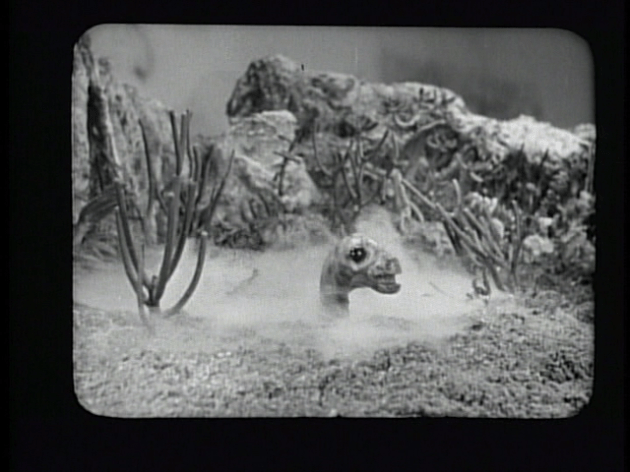
And the entire planet said, “Awwwww!”
By far my favorite part, however, is the quick shot of a group of carnivorous dinosaurs, possibly Allosaurs, who are wandering around with such a listless, seemingly depressed attitude that it was backed up and replayed repeatedly until everyone in the house had seen it.
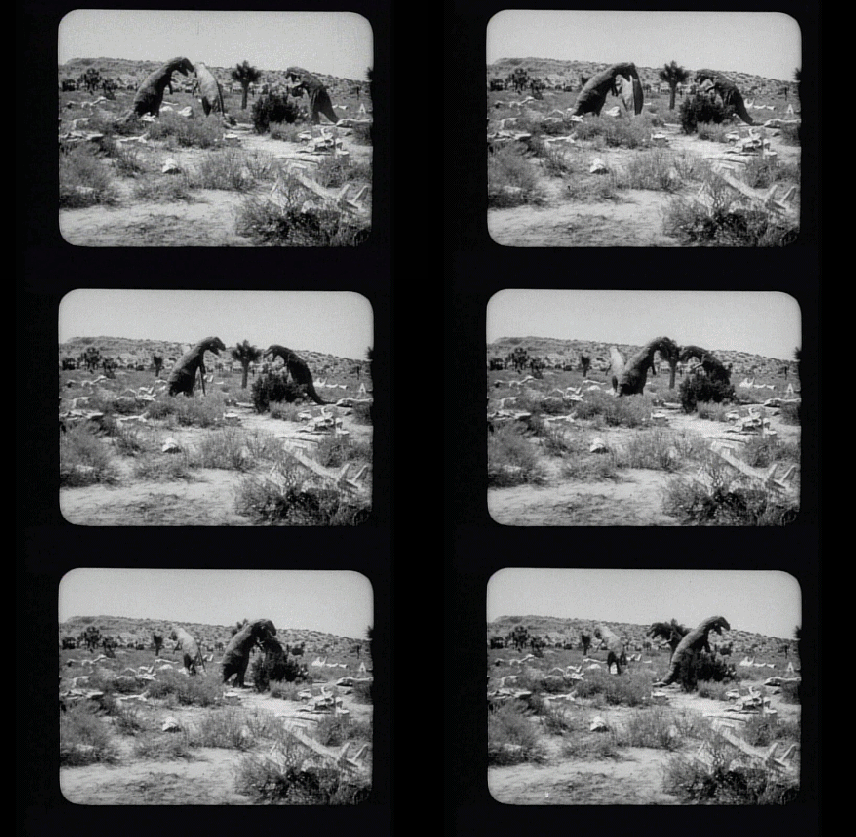
“I’m hungry…but what’s the point, our prey would probably just escape anyway…”
Gigantis the Fire Monster was a failure in the U.S., and no Godzilla movie would ever again be altered heavily in such a manner. Today, the U.S. version is perhaps most well-known for a famously questionable dub choice, in which Tsukioka responds to Hidemi’s claim that he is brave with the phrase, “Ah, banana oil!” This was ‘20s slang that essentially meant “bullshit,” and was long outdated by the time of the film’s U.S. release in 1959, but they needed something that started with a “b” to match the actor’s lips. Beyond that, the dub version is notable as George Takei’s very first acting role in Hollywood.
Godzilla Raids Again is ultimately a curiosity at best. As a piece of Godzilla’s history, it’s somewhat worth seeing where so many later staples of the franchise originated, but on its own merits, it’s an aggressively mediocre film with little to recommend it. Obsessive Godzilla fans like yours truly will want to watch it for completion’s sake, but those with less time on their hands for kaiju viewing should probably jump straight from Gojira to Godzilla’s third film, featuring his showdown with the undisputed king of American monster movies.
Buy Godzilla Raids Again on Amazon


 Just Ahead of the Curve